THE HISTORICAL PREFACE
The first Legislative Assembly election in West Bengal, held concurrently with the Indian General Election of 1951-1952, stands as a landmark in the democratic history of Asia. This election was conducted under the shadows of the 1947 Partition, which had divided the Bengal province into West Bengal (India) and East Bengal (then East Pakistan). The state was in a precarious position, managing the displacement of millions while attempting to establish a stable government. This election was the first time the people of the state exercised their right to vote under universal adult franchise, marking a transition from colonial rule to a sovereign democratic republic.
THE CHALLENGES OF A DIVIDED STATE
To understand the 1951-52 election, one must first look at the environment in which it was held. West Bengal was a state under immense pressure.
The Refugee Crisis: Between 1947 and the date of the election, more than 2.5 million Hindus had crossed the border into West Bengal. The rehabilitation of these refugees became the primary political issue.
Economic Instability: The jute industry, which was the backbone of the state’s economy, was crippled because the raw materials were now grown in East Pakistan while the mills remained in West Bengal.
Social Unrest: The Tebhaga movement and various labor strikes led by communist factions created a volatile political atmosphere in rural and industrial pockets.
THE ADMINISTRATIVE AND LOGISTICAL MARVEL
The 1952 election was an administrative feat. In a state where literacy was limited, the Election Commission had to ensure that every citizen could identify their candidate.
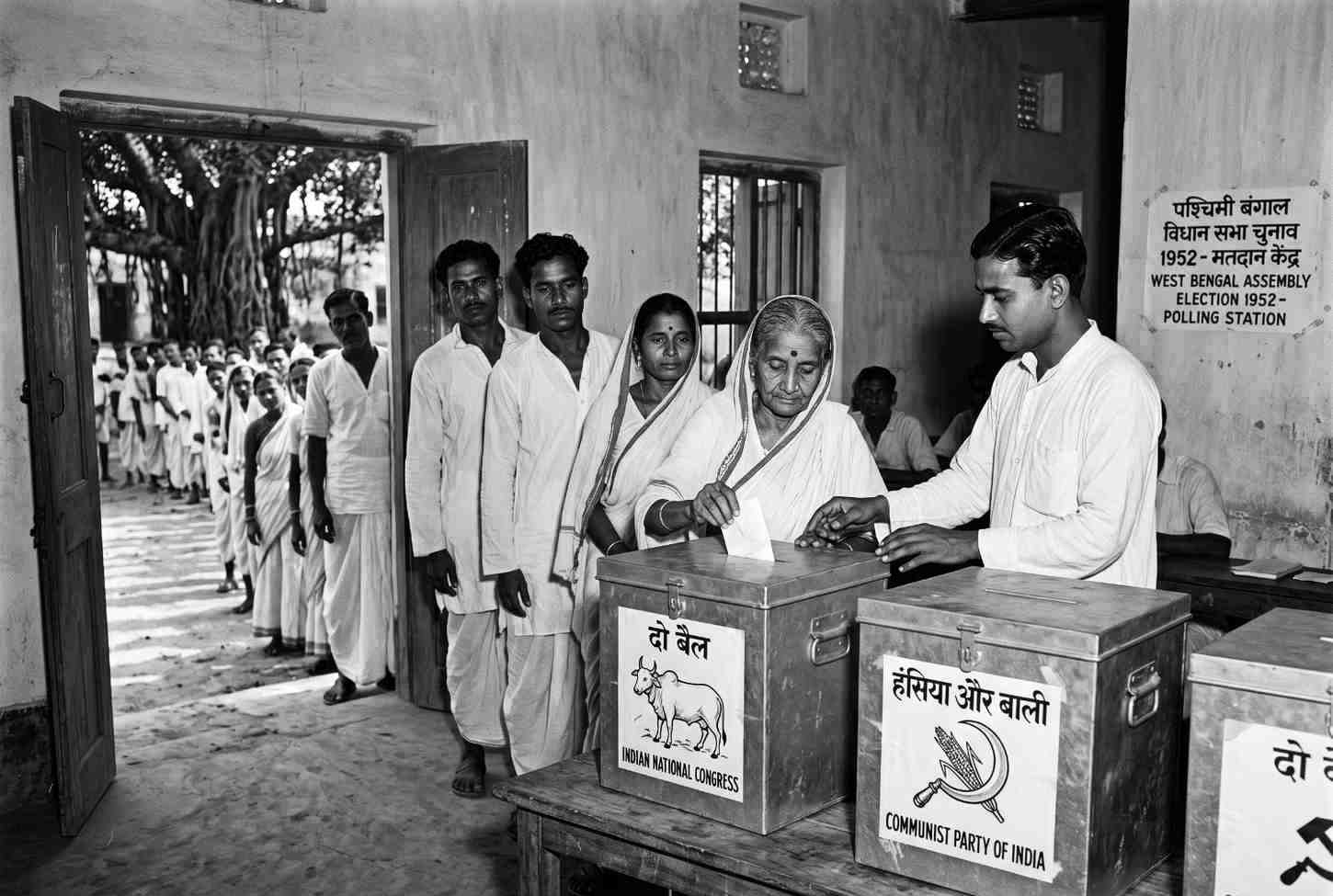
The Ballot Box System: Unlike the single ballot paper used later, this first election used a separate ballot box for every candidate. Each box had a symbol (like the bullocks for Congress or the sickle for the Communists). Voters would enter a screened compartment and drop their paper into the box belonging to their preferred candidate. This ensured secrecy and allowed illiterate voters to participate without assistance.
MAJOR POLITICAL PARTIES AND LEADERS
The political landscape was divided into three distinct camps:
THE INDIAN NATIONAL CONGRESS (INC): Led by Dr. Bidhan Chandra Roy (B.C. Roy), the Congress was seen as the architect of the new West Bengal. Dr. Roy, a physician and close associate of Mahatma Gandhi, campaigned on a platform of "reconstruction." He promised industrial centers like Durgapur and the development of educational institutions to rebuild the state’s pride.
THE COMMUNIST PARTY OF INDIA (CPI): The CPI was the most organized opposition. They focused on the urban poor, industrial workers, and landless peasants. They used the slogan "Langal Jaar Jomi Taar" (The land belongs to those who plow it). Jyoti Basu emerged during this period as a fiery leader of the opposition.
THE KISAN MAZDOOR PRAJA PARTY (KMPP): Founded by J.B. Kripalani and led in Bengal by Dr. Prafulla Chandra Ghosh, this party consisted of former Congress leaders who felt the INC had moved away from Gandhian simplicity and rural focus.
THE ALL INDIA FORWARD BLOC: Founded by Subhash Chandra Bose, the Forward Bloc remained a significant emotional force in Bengal, split into various factions but maintaining a strong presence in the northern and eastern districts.
DETAILED ELECTION STATISTICS
Total Assembly Seats: 238 Total Registered Voters: 17,628,239 Total Polled Votes: 7,443,903 Voter Turnout Percentage: 42.23% Total Candidates: 1,029
The election was held in several phases, starting in October 1951 and concluding in late March 1952.
THE VERDICT AND SEAT DISTRIBUTION
The results of the 1952 election were a victory for the Congress, but they also established West Bengal as a stronghold for Left-wing politics in India.
Indian National Congress: 150 Seats Communist Party of India: 28 Seats Kisan Mazdoor Praja Party: 15 Seats Forward Bloc (Marxist): 11 Seats Bharatiya Jana Sangh: 9 Seats Hindu Mahasabha: 4 Seats Independents: 19 Seats Others: 2 Seats
ANALYSIS OF THE RESULTS
The Congress victory was driven by its strong rural base and the personal stature of B.C. Roy. However, the performance of the CPI in 28 seats was a major turning point. The Communists won heavily in the industrial suburbs of Kolkata (then Calcutta), Howrah, and 24 Parganas. This set the stage for a "Two-Pole" political system in West Bengal that would dominate for decades.
One of the most notable results was the victory of Jyoti Basu from the Baranagar constituency, where he defeated his Congress rival by a significant margin. This established him as a permanent fixture in the state’s legislative history.
THE LEGACY OF THE 1952 ASSEMBLY
The first elected government of West Bengal under B.C. Roy undertook several massive projects that define the state today:
The Durgapur Industrial Township: Planned as a center for steel and heavy engineering.
The Salt Lake Project: Aimed at expanding the city of Kolkata to provide housing for the growing population.
Land Reform Acts: The first steps toward abolishing the Zamindari system were debated and initiated during this period.
Linguistic Reorganization: The 1952 assembly eventually led the way for the 1956 reorganization of states, which saw parts of Purnia and Manbhum (now Purulia) transferred to West Bengal.
CONCLUSION
The first election of West Bengal in 1951-1952 was a triumph of the democratic spirit. Despite being a "truncated" state struggling with the massive human cost of Partition, the citizens of West Bengal chose to build their future through the ballot box. It established a political culture that was intellectually driven, highly debated, and fiercely competitive. For historians and political analysts, the 1952 election remains the foundation upon which the modern political identity of West Bengal was built.